
Jurgen Leon (17) has autism and lives on the island of St. Eustatius. This places him in a difficult position. On this island in the Caribbean Netherlands, the care and support available to him is minimal. His mother Maya does everything for him. ‘Basically, I decided that if my child doesn’t get the care he needs, I’ll arrange it myself. But not every parent is capable of making that kind of effort.’
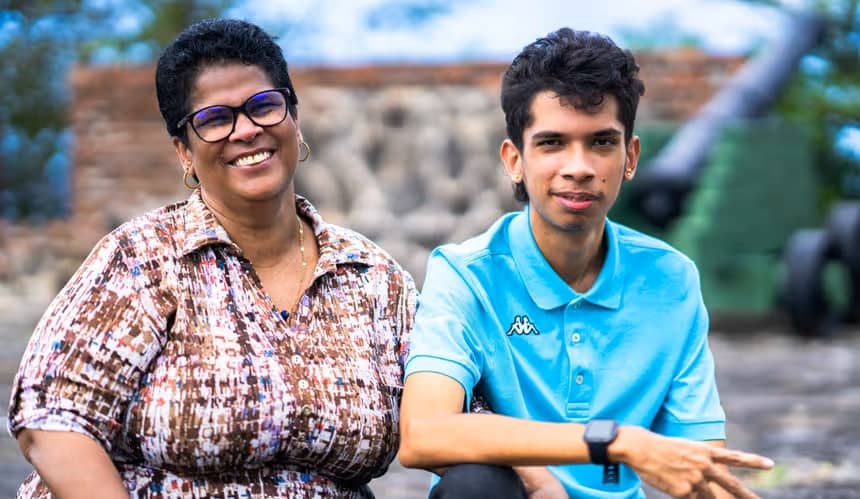
Image: © DuoBrandits
Jurgen Leon and his mother Maya Pandt
In the United States, there are specialist autism assistants in the classroom. Here, parents can request a meeting, but you’re not really taken seriously.
Before we start, Jurgen Leon (17) says that he feels a little stressed about the interview. He has autism, which makes living on St. Eustatius anything but easy. This is not a pleasant story to tell. On this island in the Caribbean part of the Netherlands, with its 3,000 inhabitants, there is music playing everywhere. ‘People say they can’t live without it, but they’ve no idea how much those thumping noises get to me. No one here knows what autism is and there’s virtually no care or support.’ This is why Jurgen has agreed to do the interview despite feeling stressed: ‘I want people to hear my story.’
When Jurgen was around the age of three, his mother Maya suspected that there was something wrong. He was slow to develop verbal skills and mainly communicated by pointing at things. It had not yet occurred to her that this could be autism. It was only when, a year later, she saw a TV interview with American actor Holly Robinson Peete, that everything fell into place. Peete was talking about her son Rodney who also struggled with autism and this resonated with Maya.
She completed a test on an American website, which confirmed that it was very likely that Jurgen was on the autistic spectrum, she says. The website recommended enlisting the services of a professional as soon as possible. But because of the lack of professionals on the island, it took another three years for Jurgen, by then aged seven, to be tested and given an official diagnosis. ‘Effectively, that was all’, responds Jurgen with resignation. ‘After that, we were more or less left to our own devices.’
‘At primary school, some of the teachers did their best to connect with you’, points out Maya. ‘Jurgen was also given speech therapy, which helped him a lot.’
If I didn’t understand it, the teacher would just repeat the same explanation that made no sense to me. That didn’t clarify anything.
Little attention to additional guidance
‘It was at secondary school that things really started to go wrong’, says Jurgen. ‘At that point, the little bit of care that I was getting just stopped.’ In addition, just a few years before he went to secondary school, there was radical reform of the curriculum on St. Eustatius. Before that, the island had the same education system as in the Netherlands. But because the island residents mainly speak English, the authorities had decided to switch to the British CXC education system. Maya: ‘The teachers suddenly had to work in a completely different structure without being properly prepared for it. They just had no time left over to explain things to Jurgen. “We’ve got more students in the class”, they used to tell me.’
‘The teachers were limited in how they could work’, says Jurgen. ‘They explained how you should solve a maths problem and that was that. If I didn’t understand it, the teacher would just repeat the same explanation that made no sense to me. That didn’t clarify anything
Mathematics was a major problem, agrees Maya. ‘Especially because Jurgen also has dyscalculia and his maths teacher in the second and third year had no idea about the CXC system.’ The problem is not the system itself, she says. ‘The teachers just didn’t understand what options were available. Especially in the early years, they were still on a steep learning curve and had hardly any time for students who needed additional support. It’s now got to the stage that they’ve brought in teachers from the British Caribbean islands, but it’s too late for Jurgen.’
I'm hearing more stories from parents fighting the same battle against the education system and having the same frustrating conversations with teachers. Some children are truly lonely.
Even the arrival of these new teachers is not enough, she says. They may know more about the CXC system, but that hardly gives them an understanding of what someone with autism needs. ‘If they had that, they might be able to empathise slightly more’, says Jurgen. Maya explains that some schools in the U.S. have permanent classroom assistants specialising in autism. ‘Their job is to monitor the children with autism and step in if they struggle with anything. That would help enormously. Here, all parents can do is request a meeting, but you’re not really taken seriously, even then.’
By this stage, the atmosphere at school was chaotic and noisy, says Jurgen. He was continually being overstimulated. On one occasion, he angrily asked whether another student could be a bit quieter. ‘They misunderstood me, likely because of my accent, and the teacher thought I’d used the F word. I hadn’t, but I still got punished.’
‘These kind of misunderstandings happened regularly because of his accent’, says Maya. ‘The speech therapy shouldn’t have stopped after primary school.’ She did everything she could to help Jurgen. ‘Basically, I decided that if my child doesn’t get the care he needs, I’ll arrange it myself.’ She read books, did online training courses and workshops and eventually set up a charity to support other parents on the island: the JTL Autism Foundation, based on her son’s initials. ‘I now hear plenty of stories from parents who face the same struggle with the education system and have the same frustrating conversations with teachers. Some children are really lonely. It’s heartbreaking. Jurgen was lucky that he had some friends.’
‘Even they didn’t fully understand me’, responds Jurgen. ‘For example, they often didn’t grasp why I only like calm, modern pop music. But that didn’t stop them just being friends.’
Maya: ‘He was very fortunate in that. Otherwise it would have been even more difficult.’ What she finds really frustrating is when other parents now tell her that she and Jurgen are actually cited as role models. ‘Look at them, say the teachers. He coped without any extra support. But they have no idea how much energy I’ve had to invest in it. It even cost me my marriage, because my ex-husband couldn’t deal with it. Not every parent is capable of making that kind of effort, and nor should they have to.’
UN Convention on the Rights of Persons with Disabilities should provide a solution, but it does not apply in Sint Eustatius
The UN Convention on the Rights of Persons with Disabilities is supposed to provide a solution. According to the convention, people with disabilities must be able to participate fully and equally in society. The convention also states that people with disabilities and the organisations that represent them must be fully involved in policy and regulation from the outset. For education, this means that there must be a careful assessment of the needs of students with disabilities. This includes such things as classroom assistants, support materials to help with lessons, as well as support and training for teachers. ‘None of that is happening here yet’, insists Maya. The convention does not apply to St. Eustatius. Although the Netherlands ratified the UN Convention on disability rights in 2016, it only did this for the European Netherlands and not for the Caribbean Netherlands. In addition to St. Eustatius, the islands of Saba and Bonaire are also part of the Caribbean Netherlands. The convention does not apply on those islands either.
Maya finds this regrettable. ‘People with disabilities struggle to get work on the island and often find it difficult or impossible to access public places.’ Her mother is a wheelchair user and can hardly go anywhere. ‘We recently took a flight to a different island and several men had to lift her and her wheelchair onto the plane. Even government buildings are inaccessible. If you’re in a wheelchair and apply for a passport, you also have to be carried into the building. On St. Eustatius, only the bus for elderly people offers wheelchair access.’ The convention would equip her with the tools she needs to campaign for improved access.
In her son’s view, there should be services offering care and advice about autism, ADHD and other neurodivergent conditions. ‘Just like in other countries.’ Maya: ‘There isn’t even a psychologist based permanently on the island. Once every fortnight, a psychologist flies over from Bonaire to hold a consultation. That’s nowhere near enough.’
There’s a big stigma: people prefer not to admit that their child has autism.
In order to make her point, she tries to bring parents together. But it is a complicated process. ‘There’s a big stigma: people prefer not to admit that their child has autism. With my charity, I try to counter that by distributing educational videos on social media. People with a neurodivergent brain aren’t crazy! They just function slightly differently, which can be extremely valuable.’ She is also attempting to convey this message to government. ‘Because that’s where it all goes wrong’, she says sadly. “The ministries in The Hague could do an awful lot more if only the island authorities would ask them to. But they don’t do it, because they can’t see the problem.’
People sometimes ask her why she does not just leave the island. ‘My brother did just that’, says Maya. He also has a daughter with autism. They’re now living in Ermelo, and getting proper support. But my brother had to give up his job as a migration supervisor to do that. I don’t want to leave the island, Jurgen should get the support he’s entitled to here.’
Jurgen is now free from the horrors of secondary school. He was last there in June. ‘I spent five whole years there, the worst five years of my life.’ He did not pass the final examination. ‘You’re only allowed to fail one subject, says Maya. That was obviously going to be the case for maths, because it was just problematic.’ But Jurgen’s marks for physics also failed to make the grade. Maya: ‘It came as a surprise to us. His average mark was a pass up till then, and now suddenly that’s changed. I’ve asked the school to see his final examination work. We’re waiting for that now.’
Jurgen has no plans to return to secondary school. This is why he is doing American high school online. ‘That’s going better’, says Maya. ‘They take his needs more into account and compensate for his dyscalculia.’ Jurgen himself is resigned to the fact that he still has no secondary school diploma. ‘I’ve set myself other goals’, he says, with determination. ‘I want to become a professional footballer and I train for that every day. There’s no official competition here on the island, but if I work hard, I hope to be able to go to the U.S. or the Netherlands to be picked up by a scout.’ Maya knows that this will be difficult. ‘But he still has my full support. That’s what he wants, he enjoys it and who knows where it will take him.’
Interview by Arend Hulshof
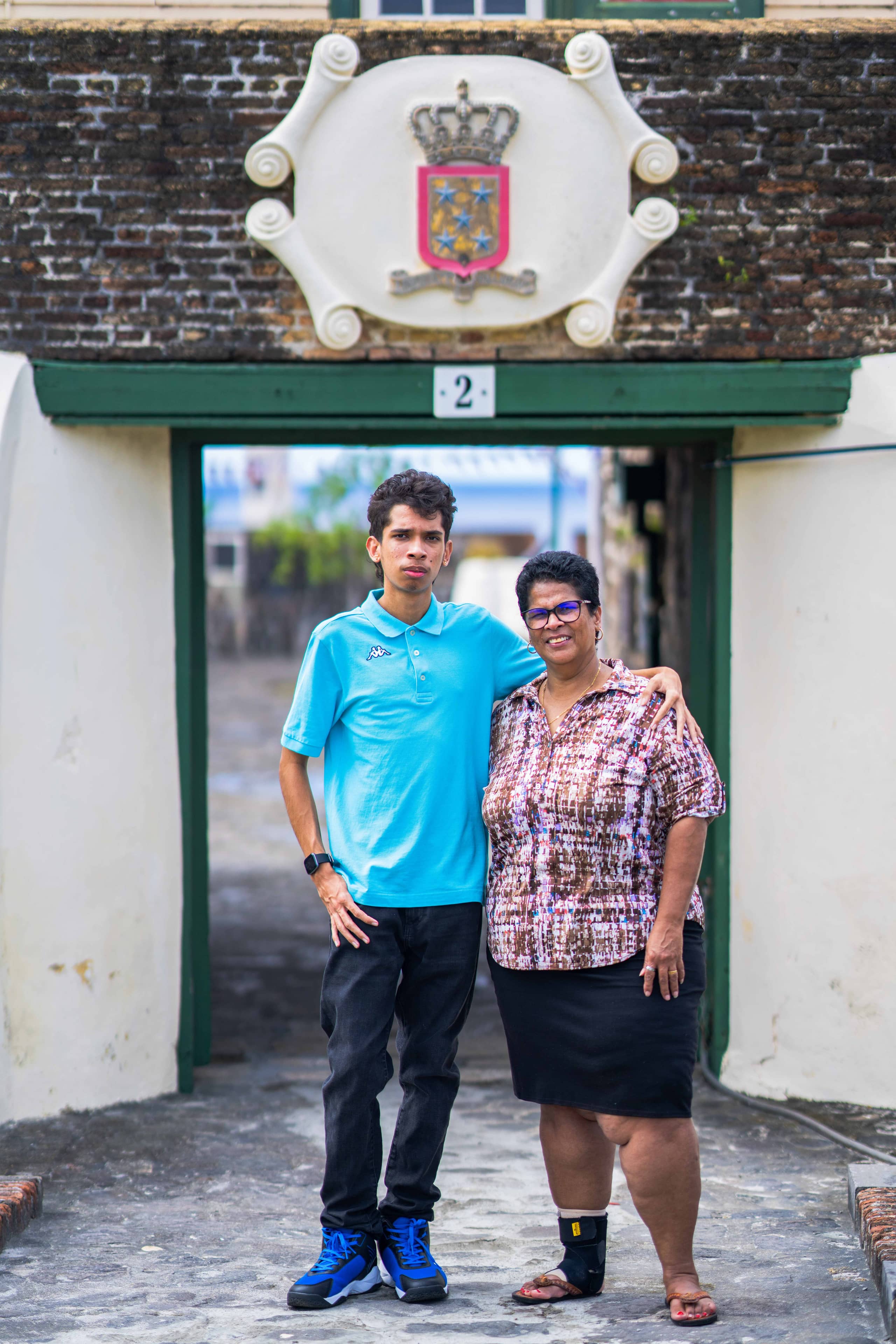
Image: © DuoBrandits
Jurgen Leon and his mother Maya Pandt